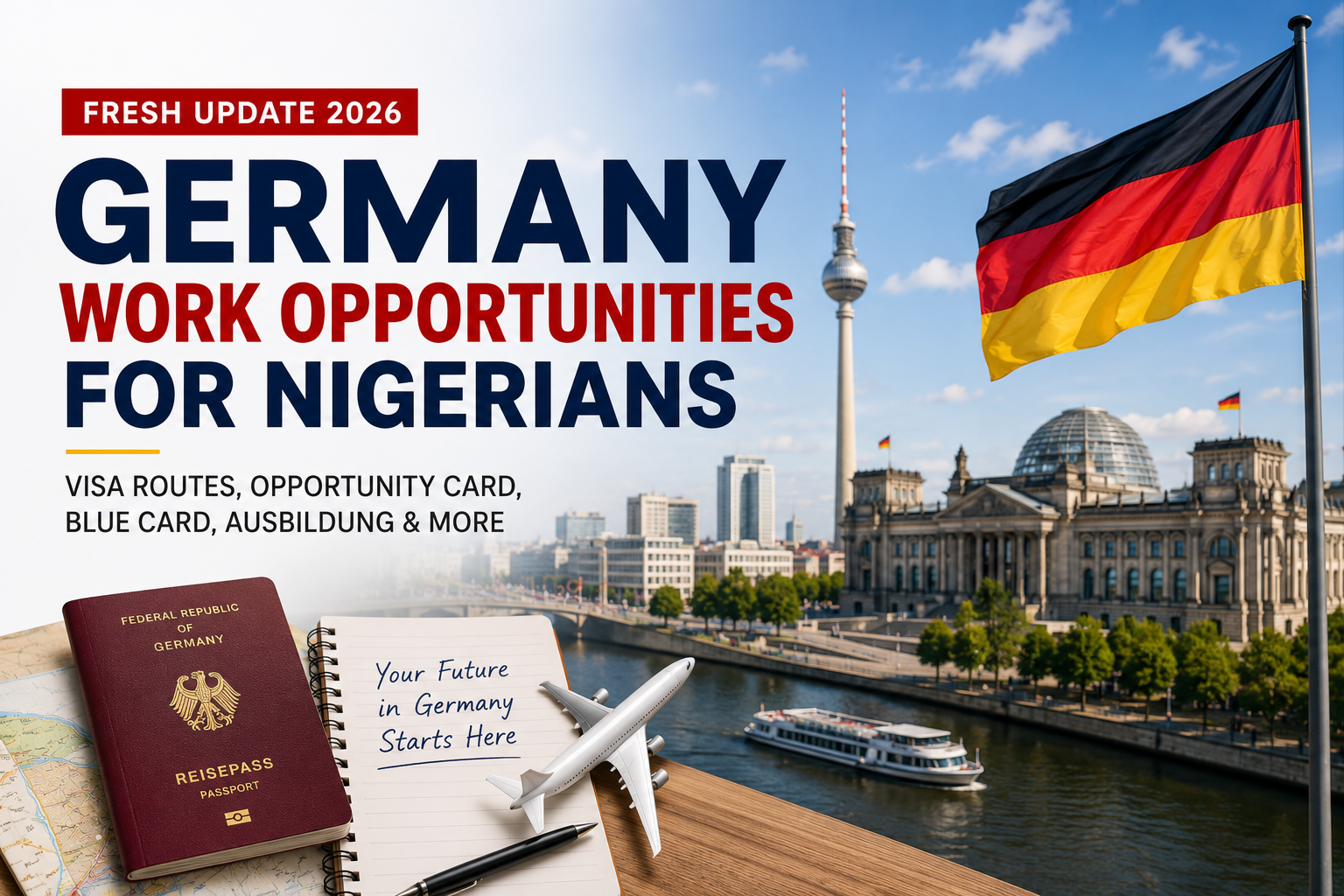
Germany continues to strengthen its immigration pathways for qualified workers and international professionals as the country seeks to attract talent from outside the European Union.
For Nigerians considering Germany as a destination for employment, professional development or vocational training, there are several routes worth exploring in 2026.
These include the Opportunity Card, Skilled Worker Visa, EU Blue Card, Professionally Experienced Worker Visa, Recognition Partnership and vocational training (Ausbildung). There are also specific provisions for IT professionals, healthcare workers and professional drivers.
The requirements vary considerably from one route to another, so choosing the correct pathway is an important first step.
Germany’s Skilled Immigration Framework
Germany’s skilled immigration reforms have created more opportunities for qualified workers from non-EU countries.
One of the most significant changes is that applicants are no longer limited to routes where they already have a German employer. The Opportunity Card, for example, provides an avenue for eligible skilled individuals to travel to Germany to search for employment.
At the same time, people who already have a suitable German job offer can consider employment-based routes such as the Skilled Worker Visa, EU Blue Card or Professionally Experienced Worker Visa.
Germany’s official “Make it in Germany” portal currently lists several residence routes for international workers, including skilled workers, professionally experienced workers, IT professionals, recognition partnerships and vocational trainees.
1. Germany Opportunity Card
The Opportunity Card (Chancenkarte) is one of the most significant options available to qualified non-EU nationals who want to find employment in Germany.
Unlike a traditional employment visa, applicants do not necessarily need to have a job offer before travelling to Germany.
The Opportunity Card is designed to allow eligible individuals to enter Germany and search for suitable employment.
There are two main ways to qualify.
Option 1: Recognised qualification
Applicants who have a foreign academic or vocational qualification that is fully recognised in Germany can qualify as skilled workers and do not need to use the points system.
Option 2: Points system
Applicants whose qualifications have not been fully recognised in Germany can potentially qualify through the points system.
They need to meet the basic requirements and obtain at least six points.
Opportunity Card Points System
Points can be awarded for factors including:
| Criteria | Points |
|---|---|
| Partial recognition of qualification | 4 |
| Qualification in a shortage occupation | 1 |
| At least 2 years’ relevant work experience | 2 |
| At least 5 years’ relevant work experience | 3 |
| German A2 | 1 |
| German B1 | 2 |
| German B2 or higher | 3 |
| English C1 or higher/native speaker | 1 additional |
| Age up to 35 | 2 |
| Age 35–39 | 1 |
| Previous qualifying stay in Germany | 1 |
| Qualifying spouse/partner | 1 |
Applicants using the points-based route need a minimum of six points.
Financial Requirement for the Opportunity Card
Applicants must demonstrate that they can financially support themselves while searching for employment.
In 2026, the required amount is generally €1,091 net per month.
This can be demonstrated through an appropriate blocked account or a declaration of commitment.
Can You Work With an Opportunity Card?
Yes.
While searching for employment, an Opportunity Card holder may undertake part-time employment of up to 20 hours per week.
The holder can also undertake job trials of up to two weeks per employer, subject to the applicable conditions.
The Opportunity Card is initially issued for up to one year.
Once the applicant finds suitable employment, they can potentially switch to an appropriate residence permit for employment, vocational training or another qualifying purpose.
Who should consider this route?
The Opportunity Card may be particularly attractive to:
- University graduates
- Skilled professionals
- Experienced workers
- IT professionals
- Engineers
- Healthcare professionals
- Technical specialists
- Professionals in shortage occupations
- Qualified tradespeople
2. Germany Skilled Worker Visa
The Skilled Worker Visa provides a direct route for qualified professionals who have secured suitable employment in Germany.
To qualify, an applicant generally needs:
- A recognised foreign academic qualification or qualified vocational qualification
- A specific job offer from a German employer
- A qualified position
- The required professional licence where the occupation is regulated.
Germany defines qualified employment as work that normally requires skills and knowledge acquired through academic studies or qualified vocational training. Auxiliary positions alone do not meet this requirement.
An important feature of the current rules is that, for this particular skilled-worker route, the job does not necessarily have to be related to the applicant’s qualification.
Regulated professions remain subject to their professional licensing requirements.
Applicants Over 45
Applicants aged over 45 who are coming to Germany to work for the first time face an additional requirement.
For 2026, the employment generally needs to provide a gross annual salary of at least:
€55,770
Alternatively, the applicant may need to demonstrate adequate pension provision, depending on the applicable rules.
3. EU Blue Card
The EU Blue Card is designed for highly qualified professionals with suitable employment in Germany.
It is particularly relevant to professionals working in areas such as:
- Information technology
- Engineering
- Mathematics
- Natural sciences
- Medicine
- Dentistry
- Pharmacy
- Nursing and midwifery
- Architecture
- Education
- Certain management positions.
For 2026, the standard minimum salary for the EU Blue Card is:
€50,700 gross per year
For recognised shortage occupations, the lower salary threshold is:
€45,934.20 gross per year
The lower threshold can also apply to certain recent graduates entering the labour market.
Blue Card for Recent Graduates
Germany has also expanded the Blue Card opportunity for people entering the labour market.
If an applicant obtained their last university degree or equivalent qualification less than three years ago, they can potentially qualify for an EU Blue Card with a job offering at least:
€45,934.20 gross per year in 2026
This provision applies to entry-level employment across professional fields, subject to the other requirements.
This creates an interesting pathway for Nigerian graduates who recently completed their university education and secure suitable German employment.
4. EU Blue Card for IT Professionals Without a University Degree
One of the particularly interesting provisions is the special opportunity available to certain experienced IT professionals.
A formal university degree is not always required for an IT professional seeking an EU Blue Card.
An applicant without a formal qualification can potentially qualify if they:
- Have a specific IT job offer in Germany
- Have employment for at least six months
- Earn at least €45,934.20 gross per year in 2026
- Have at least three years of IT experience during the previous seven years
- Can demonstrate that the professional experience is at university level and relevant to the employment.
This could be particularly relevant to experienced Nigerian:
- Software developers
- Cybersecurity specialists
- Cloud engineers
- Systems administrators
- IT managers
- Data professionals
- Other technology specialists.
5. Visa for Professionally Experienced Workers
Germany also provides a pathway for people with substantial professional experience who want to work in a non-regulated profession.
This route can be particularly useful because full formal recognition of the qualification according to German standards is not necessarily required.
Generally, applicants need:
- A foreign academic or vocational qualification recognised by the country where it was obtained
- At least two years of relevant professional experience within the last five years
- A concrete job offer in Germany
- Employment in a non-regulated profession
- The required salary
- Approval from the Federal Employment Agency where applicable.
For 2026, the general minimum salary is:
€45,630 gross per year
For applicants over 45, the applicable salary is generally:
€55,770 gross per year
unless the alternative pension provision requirement applies.
Special IT Provision
Germany has a special provision for experienced IT professionals under this route.
For qualifying IT specialists, formal proof of an academic or vocational qualification may not be required.
Professional experience and the other requirements of the route become particularly important.
This gives experienced technology professionals another potential route into the German labour market.
6. Recognition Partnership
Another route that deserves attention is the Recognition Partnership.
This is particularly relevant to professionals whose qualifications need to go through a recognition process.
Under a recognition partnership, an international professional can enter Germany with a suitable employer and complete the recognition process after arrival while working at the same time.
Generally, the applicant needs:
- A foreign academic or vocational qualification
- A qualification recognised by the country in which it was obtained
- A suitable job offer from a German employer
- The relevant evidence of qualification comparability
- The required language ability and other conditions.
Once full recognition is obtained, the worker can potentially transition to a skilled-worker residence permit or EU Blue Card, depending on the circumstances.
This can be especially relevant to professionals whose occupations require German recognition before full professional practice.
7. Ausbildung: Vocational Training in Germany
Germany also provides opportunities for people who want to acquire professional skills through vocational training (Ausbildung).
This can be an attractive option for younger Nigerians who want to build a career in Germany without following the traditional university-to-employment route.
Potential areas include:
- Nursing
- Healthcare
- Automotive technology
- Electrical occupations
- Mechatronics
- Logistics
- Hospitality
- Technical occupations
- Skilled trades.
The exact availability and entry requirements depend on the specific training programme.
Requirements for Ausbildung
Applicants generally need a specific vocational training place in Germany.
For many programmes, German language ability at B1 level is normally required where the training institution has not already assessed the applicant’s language skills or the applicant has not completed an appropriate preparatory course.
Financial requirements also apply.
Company-based/dual vocational training
A training allowance of at least:
€1,048 gross / €822 net per month
is considered sufficient to secure livelihood in 2026.
School-based vocational training
Applicants generally need to demonstrate access to at least:
€959 net per month
in 2026.
8. Professional Driver Opportunities
Germany also has specific provisions for professional drivers.
The official German immigration portal confirms that it is possible for certain foreign nationals to work as professional drivers under special regulations, including circumstances where formal vocational training is not required.
Requirements depend on the specific circumstances, including:
- The employment offer
- Driving qualifications
- Driving licence requirements
- Licence conversion
- Applicable professional requirements
- Salary
- Age.
Foreign drivers may need to convert their driving licence within the applicable period after entering Germany.
For professional drivers aged 45 or older, the applicable 2026 salary requirement is generally €55,770 gross per year, unless the alternative pension requirement applies.
9. Healthcare Professionals
Healthcare is one of the areas where international recruitment is particularly relevant.
Professionals such as nurses and other healthcare workers may have opportunities to work in Germany, but many healthcare occupations are regulated professions.
This means that immigration approval alone may not be sufficient to practise the profession.
Depending on the occupation, applicants may need:
- Recognition of their professional qualification
- Professional licence
- German-language skills
- Additional training or adaptation measures
- Other professional requirements.
Germany’s skilled-worker framework specifically notes that regulated professions require the appropriate licence to practise.
For Nigerian healthcare professionals, determining the recognition requirements should therefore be an early part of the application process.
Germany Work Routes at a Glance
| Route | Job Offer Required? | Main Target Group |
|---|---|---|
| Opportunity Card | No | Qualified jobseekers |
| Skilled Worker Visa | Yes | Qualified professionals |
| EU Blue Card | Yes | Highly qualified professionals |
| Professionally Experienced Worker | Yes | Experienced professionals |
| Recognition Partnership | Yes | Professionals requiring recognition |
| Ausbildung | Training place required | Vocational trainees |
| Professional Driver Route | Yes | Eligible professional drivers |
| Healthcare Routes | Usually yes | Qualified healthcare professionals |
Which Route Could Be Suitable for You?
Your best option depends on your personal profile.
If you are a recent university graduate
The Opportunity Card and, where the requirements are met, the EU Blue Card for recent graduates may be worth investigating.
If you already have a German job offer
The Skilled Worker Visa, EU Blue Card or Professionally Experienced Worker Visa may be relevant depending on your qualification, occupation and salary.
If you have several years of experience
The Professionally Experienced Worker route could be particularly relevant for non-regulated professions.
If you work in IT
You may have several options, including the EU Blue Card and professionally experienced worker route, including special provisions for experienced IT professionals without formal university qualifications.
If you are a nurse or other healthcare professional
The appropriate recognition and skilled-worker route should be investigated.
If you are interested in technical or practical careers
Ausbildung may provide an alternative route into Germany.
If you are a professional driver
Germany’s special professional-driver provisions may be relevant to your circumstances.
What Documents Should Applicants Prepare?
The exact documentation varies by visa category, but applicants may need:
- Valid passport
- Academic certificates
- Vocational certificates
- Professional certificates
- Curriculum vitae
- Evidence of work experience
- Employment contract or job offer
- Qualification recognition/evaluation
- Language certificate where required
- Proof of financial resources where applicable
- Health insurance
- Passport photographs
- Visa application documentation
- Professional licence where applicable.
Applicants should not assume that a qualification obtained outside Germany is automatically recognised.
Germany provides formal recognition and comparability procedures for foreign qualifications, and the requirements depend on whether the profession is regulated and which immigration route is being used.
Germany’s Digital Visa Application Process
Germany has also introduced digital services for certain national visa applications.
Through the Consular Services Portal, eligible applicants can begin applications online for several categories, including employment, study, vocational training and family reunification.
The digital process does not necessarily eliminate the need for an in-person appointment. Applicants may still need to appear in person for biometric information, document verification and other requirements.
A Practical Germany Work Migration Process
For Nigerians planning to pursue employment in Germany, the process should generally begin with eligibility assessment, rather than immediately submitting a visa application.
Step 1: Assess your profile
Review:
- Age
- Education
- Occupation
- Professional experience
- Vocational qualifications
- German language level
- English language level
- Professional licences
- Financial capacity.
Step 2: Identify the appropriate pathway
Determine whether your circumstances fit:
Opportunity Card → Skilled Worker → EU Blue Card → Professionally Experienced Worker → Recognition Partnership → Ausbildung → occupation-specific route
Step 3: Check qualification recognition
Determine whether your academic or vocational qualification needs recognition, comparability or evaluation.
Step 4: Prepare your professional profile
Develop a strong CV and gather evidence of your education and professional experience.
Step 5: Search for employment or training
Applicants who require a job offer should focus on legitimate German employers and recognised recruitment channels.
Step 6: Obtain the appropriate offer
Where required, obtain a genuine German employment contract or vocational training placement.
Step 7: Prepare the visa application
Gather the required documentation and complete the appropriate national visa process.
Step 8: Enter Germany and begin your programme
Once the required visa/residence authorisation has been granted, the applicant can travel to Germany and begin the approved employment, training or job-search activity.
Why Germany Is Becoming Increasingly Attractive to International Workers
Germany offers something particularly important for international workers: multiple pathways rather than a single immigration route.
A person with a university degree may have one option.
An experienced IT professional without a degree may have another.
A skilled tradesperson may follow a different route.
A young person may pursue Ausbildung.
A healthcare professional may use a recognition-based pathway.
And an eligible qualified jobseeker may use the Opportunity Card.
This makes profile assessment extremely important.
The strongest application is not necessarily the person with the highest qualification. It is the person who can identify the correct immigration route and demonstrate that they meet its specific requirements.
Conclusion
Germany’s 2026 immigration framework provides several legitimate pathways for international workers seeking to build careers in the country.
For Nigerians, the most relevant options include:
Opportunity Card — for eligible qualified jobseekers.
Skilled Worker Visa — for qualified professionals with suitable employment.
EU Blue Card — for highly qualified professionals meeting the relevant salary and employment requirements.
Professionally Experienced Worker Visa — for eligible experienced professionals in non-regulated occupations.
Recognition Partnership — allowing certain professionals to pursue recognition while working in Germany.
Ausbildung — for people pursuing vocational training.
Professional Driver Route — for eligible drivers.
Healthcare Pathways — for qualified healthcare professionals subject to recognition and licensing requirements.
The German labour market is increasingly accessible to qualified international talent, but eligibility depends on the applicant’s education, experience, occupation, language ability, employment offer, salary and other individual circumstances.
For anyone considering Germany in 2026, the most important first step is therefore to determine which pathway fits your profile and what requirements must be satisfied before beginning the application.
Official information
Make it in Germany — Official German Government Portal