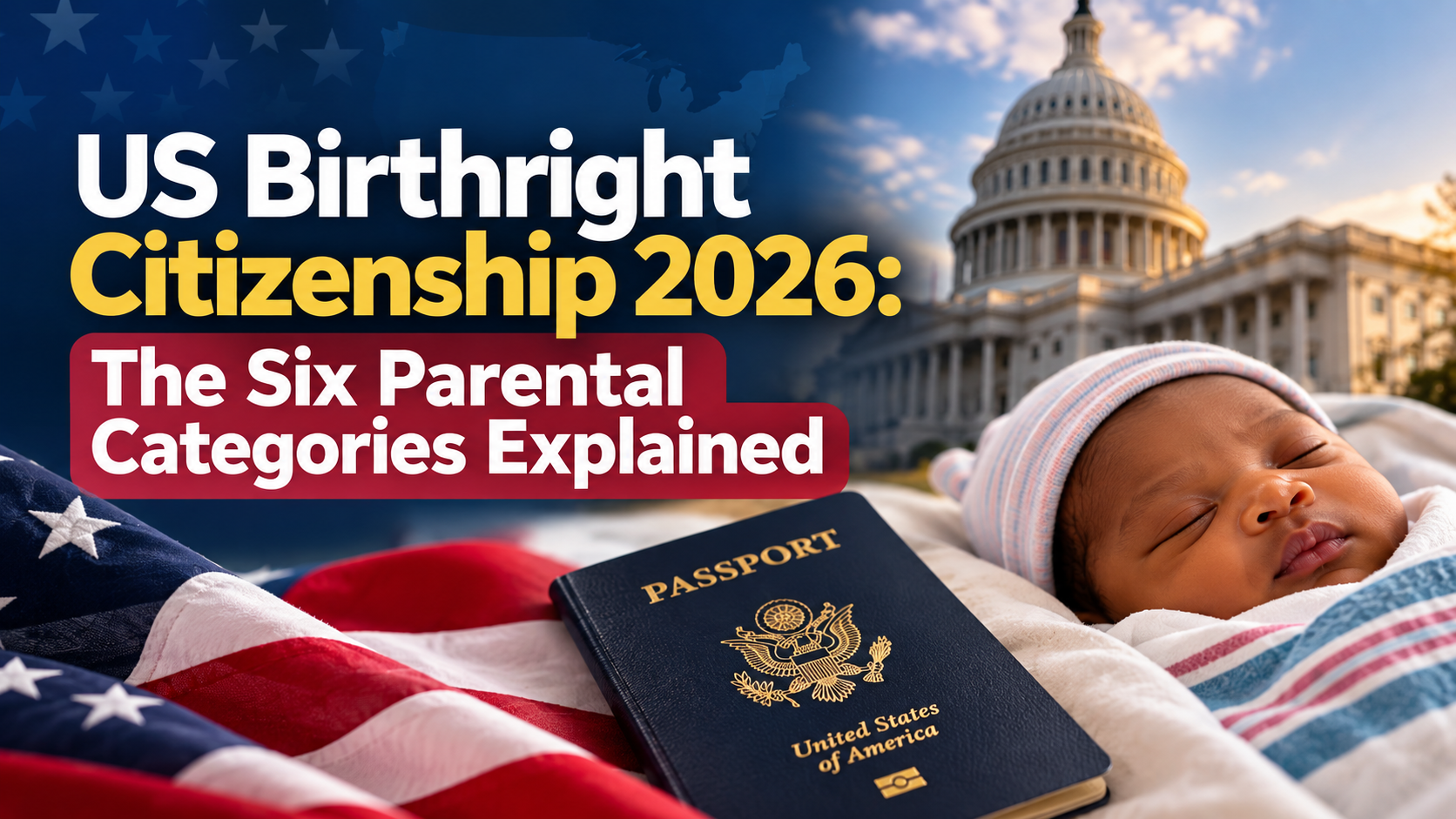
For decades, the United States has been one of the destinations considered by international families seeking medical care, educational opportunities and a better future for their children. One issue that has attracted particular attention is birthright citizenship—the principle under which a child born in the United States may acquire American citizenship at birth.
However, recent changes in US immigration policy have generated questions worldwide. Can a child born in the United States still become an American citizen if neither parent is a US citizen? Does a parent’s immigration status affect the child’s eligibility? And what do the six parental categories mentioned in recent reports actually mean?
These questions have become especially important following President Donald Trump’s executive actions on citizenship and the US Supreme Court’s June 2026 decision on birthright citizenship.
The headlines can be confusing, particularly when they suggest that six new categories have been introduced or that citizenship by birth has been abolished altogether.
In this article, we examine the constitutional basis of US birthright citizenship, the categories identified in recent executive orders, the latest legal developments and the practical implications for families and international travellers.
What Is US Birthright Citizenship?
Birthright citizenship is the acquisition of citizenship by virtue of being born in a particular country, subject to the laws of that country.
In the United States, the principle is principally rooted in the Fourteenth Amendment to the US Constitution. Its Citizenship Clause states that people born or naturalised in the United States and subject to its jurisdiction are citizens of the United States and of the state where they reside.
Under the longstanding interpretation of this provision, most children born on US soil acquire American citizenship at birth, even when their parents are foreign nationals, temporary visitors or people without permanent immigration status.
There are recognised exceptions, including certain children born to foreign diplomatic officials.
The debate intensified on January 20, 2025, when President Trump signed Executive Order 14160, seeking to deny citizenship to certain children born in the United States to parents who were unlawfully present or temporarily in the country.
On June 30, 2026, however, the US Supreme Court ruled in Trump v. Barbara that children born in the United States to parents who are unlawfully or temporarily present are citizens at birth under the Fourteenth Amendment.
The Court’s ruling rejected the central restriction in the 2025 executive order.
Nevertheless, the administration subsequently issued new executive orders addressing narrower categories of cases and attempting to restrict birth tourism. These developments have made it essential to distinguish the constitutional rule from the administration’s policy objectives and the legal effect of its newer measures.
What Are the Six Parental Categories Mentioned in Recent Reports?
The phrase “six parental categories” can be misleading. The newer executive order does not set out a simple, numbered list of six ordinary parental immigration statuses. Instead, Executive Order 14418, signed on August 6, 2026, identifies several circumstances in which the administration says citizenship documentation should not be issued or accepted when neither parent is a US citizen.
The following breakdown explains six important situations or subcategories discussed in the order. It is an explanatory grouping, not an official list of six independently established legal exceptions.
1. A parent classified as an enemy of the United States
The order identifies circumstances involving a parent classified as an “alien enemy,” including certain members of designated foreign terrorist organisations and specially designated global terrorists under the relevant US legal provisions.
This is a specialised legal classification. It does not mean that ordinary foreign nationals, immigrants or visitors are automatically classified as enemies of the United States.
The application of this provision must be considered in the context of the Constitution, existing citizenship law and applicable court decisions.
2. A parent who is a foreign ambassador
Children of certain foreign diplomatic officials have historically fallen within recognised exceptions to US birthright citizenship.
The newer order specifically identifies ambassadors in its discussion of foreign-government employees.
Diplomatic status is a legally significant factor and should not be confused with the ordinary immigration status of someone visiting the United States for tourism, business or family reasons.
3. A parent employed by a foreign embassy or consulate
Another category concerns people employed by a foreign embassy or consulate who are nationals of the foreign country they represent.
This provision is narrower than a general rule covering everyone who works for a foreign organisation. Its wording refers to particular employment and nationality circumstances.
The relevant diplomatic arrangements and legal requirements must be considered when assessing a specific case.
4. A parent employed by a foreign government in an official capacity
The order also identifies people employed by a foreign government in an official capacity.
This is distinct from being employed by a private international company, a foreign-owned business or a non-governmental organisation.
Whether a particular employment relationship falls within this category depends on the applicable legal definitions and the circumstances of the case.
5. A parent employed by an international organisation with immunity
The executive order refers to employees of international organisations who possess international-organisation immunity.
This provision does not automatically cover every employee of every international organisation. The relevant immunity and employment status matter.
It is important to distinguish this category from ordinary employment with international charities, humanitarian organisations or private businesses.
6. Commercial arrangements or fraudulent activity involving birthright citizenship
The order also addresses circumstances in which a parent engages in a commercial transaction to purchase or access birthright citizenship, or participates in fraudulent activity to obtain citizenship.
The examples include arrangements made to ensure that a mother is present in the United States to give birth, as well as certain commercial surrogacy arrangements involving a surrogate in the United States.
These provisions are related to the administration’s stated effort to restrict birth tourism and fraudulent citizenship arrangements. They should not be interpreted as meaning that every pregnant visitor automatically loses eligibility for a visa or that every child born to a foreign national is excluded from citizenship.
The order separately discusses births in certain US territories or territorial waters where citizenship is not conferred by federal statute. That is a distinct geographical and legal issue, rather than a parental immigration status.
Important legal distinction: Executive Order 14418 states the administration’s policy. Its provisions must be read alongside the Constitution, federal citizenship statutes and relevant court rulings. The order itself does not replace judicial review or independently resolve every constitutional question.
You can consult the official text of Executive Order 14418 for the exact wording.
Does a Foreign Parent’s Immigration Status Affect a Child’s US Citizenship?
This is one of the most important questions for families worldwide.
Under the longstanding general rule, a child born in the United States generally acquires American citizenship at birth, even when the parents are not US citizens or permanent residents.
The Supreme Court’s June 2026 decision reaffirmed that children born in the United States to parents who are unlawfully or temporarily present are citizens at birth under the Fourteenth Amendment.
Consequently, the assertion that a child must have at least one American parent or a parent with permanent residency is not an accurate description of the general constitutional rule.
At the same time, citizenship questions involving diplomatic status, particular territorial circumstances or other recognised exceptions require separate analysis.
The newer executive orders have also introduced additional policy measures concerning birth tourism and citizenship documentation. Their practical effects should not be assumed without checking the current legal position and any applicable court orders.
For families planning international travel, the safest approach is to verify the relevant rules rather than relying on social media headlines or promotional claims.
What Does the New Policy Mean for Families Around the World?
The issue is relevant to families from every region, including Africa, Asia, Europe, Latin America and the Middle East.
Its practical implications differ depending on the family’s circumstances.
Families considering childbirth in the United States
Expectant parents may wish to understand whether their child would acquire American citizenship at birth. The general constitutional rule and the relevant exceptions are the starting points for that assessment.
However, the child’s potential citizenship is separate from the parent’s eligibility to obtain a visa or enter the United States.
Families with diplomatic or foreign-government connections
People employed in diplomatic missions, foreign governments or certain international organisations may need advice specific to their legal status.
Their circumstances can differ from those of ordinary visitors, students, workers or permanent residents.
Families considering surrogacy
International surrogacy arrangements may raise questions involving parentage, birth registration, citizenship and immigration documentation.
Parents should obtain advice on the applicable US federal and state laws, along with any laws that apply in their home country.
Families already living in the United States
Parents whose children are born in the United States should consult the relevant authorities or a qualified immigration lawyer if they are uncertain about citizenship documentation or whether a particular exception applies.
They should not assume that a headline alone determines their child’s legal status.
Can Travelling to the United States to Give Birth Affect a Visa Application?
Visa eligibility is a separate issue from a child’s citizenship at birth.
US authorities assess visa applications according to the relevant visa category, eligibility requirements and circumstances of the applicant. Travellers must provide truthful information about the purpose of their trip.
The administration signed Executive Order 14419, titled Ending Birth Tourism, on August 6, 2026. It directs government agencies to take steps concerning the use of non-immigrant visas for travel to the United States for the purpose of giving birth.
The order defines birth tourism as entry on a non-immigrant visa for the purpose of giving birth on American soil, or efforts to facilitate such entry. It also provides for certain exemptions.
This executive action is separate from the constitutional question of whether a child acquires citizenship at birth. Its implementation and legal effect should be checked against current official guidance and any applicable court orders.
Anyone considering travelling to the United States during pregnancy should therefore:
- Provide truthful information when applying for a visa.
- Understand the requirements of the visa category being sought.
- Obtain accurate information about medical costs and insurance coverage.
- Avoid agents who guarantee visa approval or citizenship outcomes.
- Check current US government guidance before making travel commitments.
For the official policy, consult Executive Order 14419 on ending birth tourism.
Does a Child’s American Citizenship Give the Parents a Green Card?
No. A child acquiring American citizenship at birth does not automatically make either parent a US citizen or permanent resident.
US immigration law provides specific family-based immigration routes, but eligibility requirements apply.
Generally, a US citizen must be at least 21 years old to petition for a parent to immigrate as an immediate relative. The parent must also meet the applicable legal requirements.
Therefore, having a child in the United States should not be treated as an immediate route to permanent residency, a work permit or citizenship for the parents.
Families should be wary of any service provider promising otherwise.
Birthright Citizenship vs. Birth Tourism: What Is the Difference?
Although these terms are often used together, they refer to different concepts.
Birthright citizenship is the legal principle under which a person acquires citizenship at birth, subject to the country’s laws.
Birth tourism generally refers to travel to another country with the intention of giving birth there, often in the hope that the child will acquire that country’s citizenship.
The first concerns the child’s legal status. The second concerns the purpose of travel and may raise separate immigration questions.
A child’s eligibility for citizenship does not automatically determine whether a parent qualifies for a visa or admission. Likewise, a parent’s visa circumstances do not by themselves settle every question concerning the child’s citizenship.
Understanding this distinction is essential when evaluating claims about US citizenship rules.
Frequently Asked Questions About US Birthright Citizenship
1. Can a child born in the United States to foreign parents become an American citizen?
Generally, yes. Children born in the United States acquire American citizenship at birth under the Fourteenth Amendment, subject to recognised exceptions. The Supreme Court’s June 2026 decision reaffirmed citizenship for children born to parents who are unlawfully or temporarily present.
2. Must one parent be an American citizen for the child to qualify?
Under the general constitutional rule, no. A child born in the United States does not ordinarily need an American parent to acquire citizenship at birth. Certain exceptions, including those involving diplomatic status, must be considered separately.
3. Has the United States abolished birthright citizenship?
No. The Supreme Court rejected the central restriction in Executive Order 14160 on June 30, 2026. Subsequent executive actions have addressed narrower categories and birth tourism, but their legal application must be assessed alongside relevant court decisions and current official guidance.
4. Are the six parental categories an official list of six exceptions?
Not exactly. The viral description is a simplified interpretation of the categories and circumstances identified in the newer executive order. The order’s wording is more specific, and its legal effect must be considered in light of the Constitution and applicable court rulings.
5. Does a US-born child automatically give the parents permanent residency?
No. The child’s citizenship does not automatically grant the parents a green card or American citizenship. Separate immigration requirements apply.
6. Can a pregnant traveller still apply for a US visa?
Pregnancy alone does not determine visa eligibility. The relevant requirements, purpose of travel and applicable policies matter. The administration’s 2026 birth tourism order introduces additional considerations, so travellers should check current official guidance before making plans.
7. Where can I find reliable information about US citizenship rules?
Consult the US Department of State, the official Supreme Court decision in Trump v. Barbara, and the relevant White House executive orders. For advice about an individual situation, seek guidance from a qualified US immigration lawyer.
Conclusion: Understanding the Law Before Making Important Decisions
The debate over US birthright citizenship has evolved significantly, from Executive Order 14160 in January 2025 to the Supreme Court’s June 2026 decision and the administration’s subsequent executive actions in August 2026.
For families worldwide, the central message is clear: the claim that the United States has introduced six parental categories should not be interpreted as proof that birthright citizenship has been abolished or that all children born to foreign parents are now ineligible for American citizenship.
The constitutional rule, recognised exceptions, the circumstances of the parents and child, and the legal status of subsequent executive actions all matter.
Anyone considering travel to the United States, childbirth abroad or an immigration application should verify the latest official information before making financial or personal commitments.
At Zinchi International, we encourage prospective travellers and families to make informed decisions based on reliable information and the requirements relevant to their individual circumstances. Our team can provide information about available visa-processing and international travel advisory services.
Contact Zinchi International to discuss your international travel plans and understand the next steps relevant to your circumstances.
Disclaimer: This article is intended for general informational purposes only and does not constitute legal advice. US immigration and citizenship rules can change, and executive actions may be affected by litigation. Consult current official sources and a qualified US immigration lawyer before making decisions about an individual case.