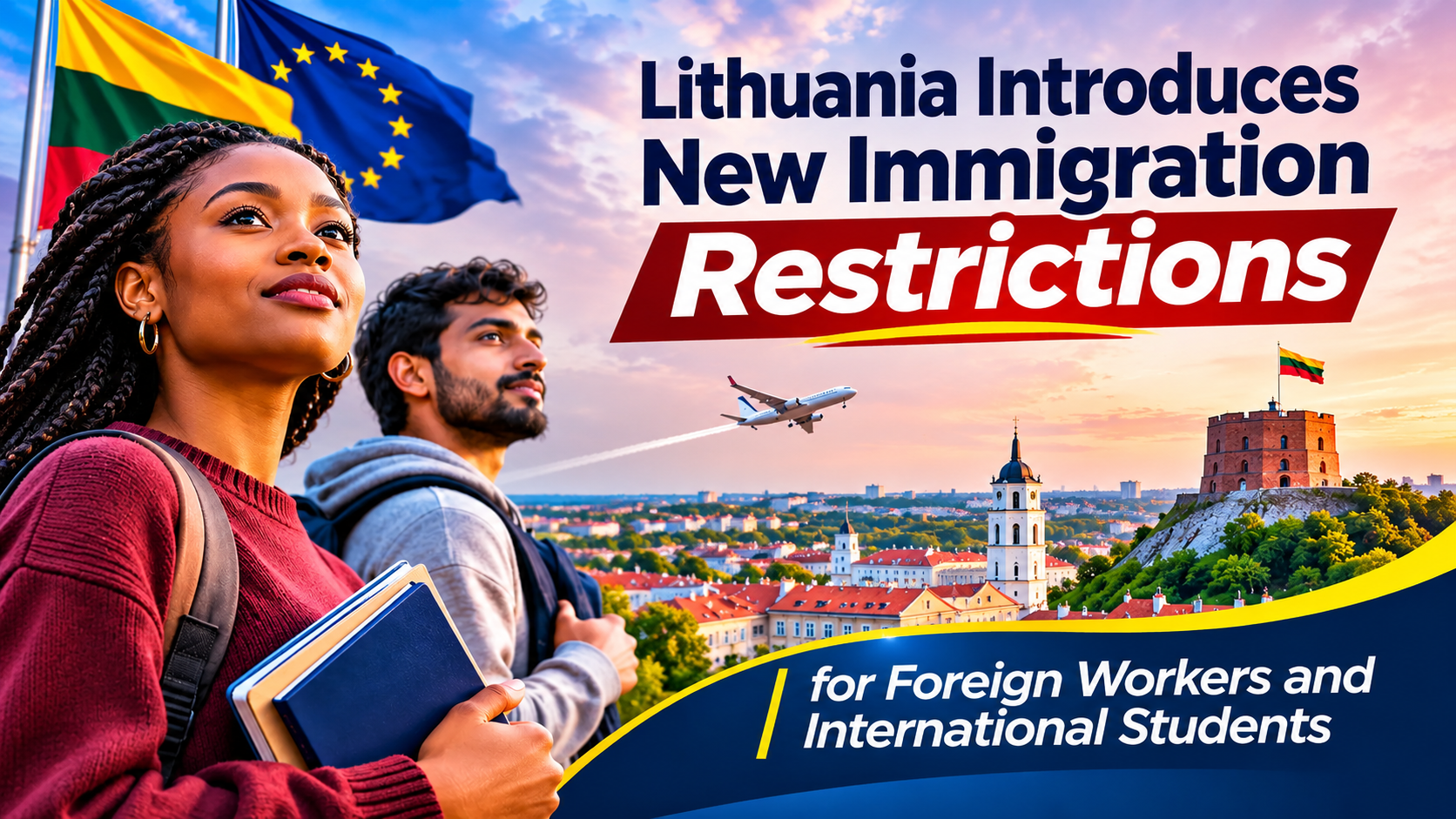
Lithuania has introduced significant changes to its immigration policies, restricting foreign workers and international students from applying for certain temporary residence permits while already inside the country.
The new regulations, effective November 1, 2026, represent a major shift in the country’s immigration framework and could affect thousands of prospective international students, foreign workers and individuals seeking long-term residency in Europe.
What Has Changed?
Under the revised immigration framework, foreign nationals entering Lithuania on certain short-stay Schengen visas or national visas issued by other countries can no longer apply for certain temporary residence permits from within Lithuania.
The restrictions primarily affect individuals who:
- Enter Lithuania on a visitor visa and subsequently secure employment.
- Obtain admission to undergraduate degree programmes while visiting the country.
- Intend to switch from short-term visitor status to employment-based residency.
- Hold certain visas issued by other European countries.
Affected applicants will generally need to submit their residence permit applications through authorised overseas application centres.
Which Countries Are Affected?
The new immigration regulations apply broadly to non-European Union nationals, including citizens of countries across Africa, Asia and other regions.
Countries affected include Ghana, South Africa, India, Azerbaijan, Cambodia and Mongolia, among others.
Some nationalities may face additional challenges due to restrictions on overseas application centres and eligibility requirements for employment-based residence permits.
What Does This Mean for International Students?
International students planning to pursue undergraduate studies in Lithuania must now pay closer attention to their immigration status before travelling.
Students entering Lithuania on short-stay Schengen visas may no longer be eligible to apply for bachelor’s degree-based residence permits without leaving the country.
However, the new restrictions do not constitute a ban on international students. Master’s and doctoral programmes are not subject to this specific restriction on undergraduate residence permit applications.
Prospective students are encouraged to secure the appropriate immigration documentation before travelling.
What Does This Mean for Foreign Workers?
Foreign nationals seeking employment in Lithuania may face additional requirements when applying for residence permits.
Individuals who enter the country on tourist or short-stay visas and subsequently receive job offers will generally need to submit their employment-based residence permit applications from abroad.
However, highly qualified professionals, including eligible EU Blue Card applicants, remain exempt from this specific restriction.
Who Is Exempt From the New Restrictions?
Foreign nationals may continue applying from within Lithuania if they meet certain conditions, including holding:
- A valid Lithuanian temporary residence permit.
- A national visa issued by Lithuania.
- A qualifying residence permit issued by another EU or Schengen country.
- Eligibility to stay in Lithuania under visa-free arrangements.
Existing residence permit renewal procedures remain largely unaffected. Daily Baltic+1
Lithuania Closes Several Overseas Application Centres
As part of the immigration reforms, Lithuania has discontinued certain long-term visa and residence permit application services at its external application centres in Kazakhstan, Kyrgyzstan, Uzbekistan, and Bosnia and Herzegovina.
The changes reduce the number of available overseas residence permit application locations from 31 to 27.
This could result in additional travel expenses and logistical challenges for prospective applicants.
Can Foreigners Still Study and Work in Lithuania?
Yes. Lithuania has not banned international students or foreign workers.
The new regulations primarily change where certain residence permit applications can be submitted and the conditions under which foreign nationals can apply.
Lithuania remains open to eligible international students, skilled professionals, researchers and other qualified migrants who meet its immigration requirements.
What Should Prospective Applicants Do?
Individuals planning to study, work or relocate to Lithuania should:
- Confirm their eligibility before making travel arrangements.
- Apply through the appropriate immigration channels.
- Identify authorised residence permit application centres.
- Avoid relying on tourist visas as a pathway to long-term residency.
- Stay informed about changes to European immigration policies.
- Seek professional immigration guidance where necessary.
Applicants can access updated information through the official Lithuanian Migration Department website.
Final Thoughts
Lithuania’s latest immigration reforms reflect an evolving immigration landscape across Europe, where governments continue to introduce stricter requirements for foreign nationals seeking employment, education and long-term residency.
While these changes may present additional challenges, opportunities remain available for applicants who meet the necessary requirements and follow the appropriate immigration procedures.
Proper planning, accurate information and professional guidance are increasingly essential for a successful international relocation journey.
Planning to Study, Work or Relocate Abroad?
At Zinchi International, we help individuals worldwide navigate international education, employment, visa applications and immigration opportunities.
Whether you are considering Lithuania or exploring opportunities elsewhere in Europe, North America, Asia or Australia, our team is here to guide you through your application journey.
Contact Zinchi International today and take the next step towards your global aspirations.