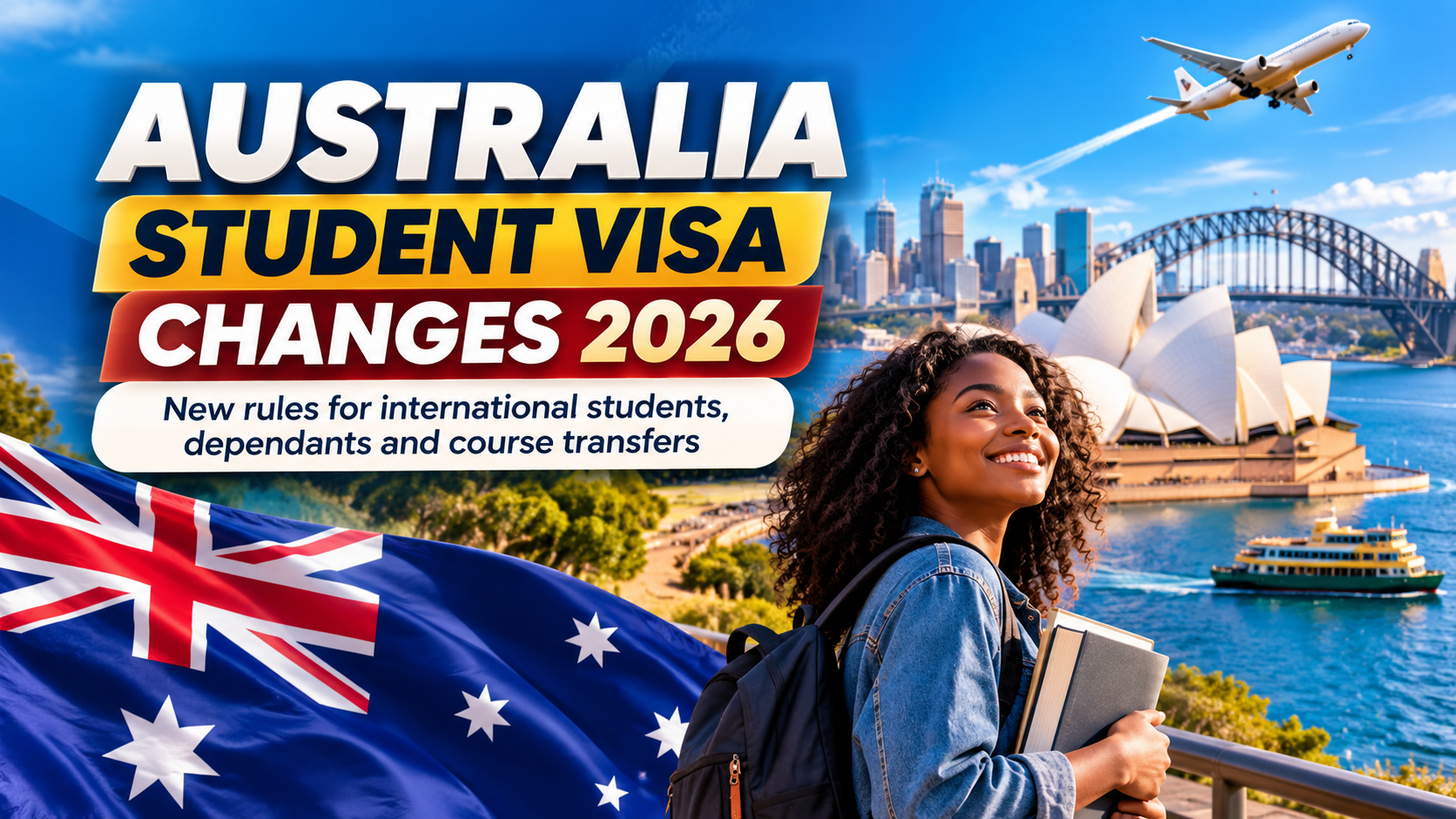
Australia remains a popular destination for international students seeking quality education, internationally recognised qualifications and opportunities to build their careers. However, prospective students need to understand the latest changes to Australia’s student visa system before making study plans.
On 2 October 2026, the Australian Government introduced new student visa integrity reforms affecting who can apply for a student visa while already in Australia, whether students can include family members in their applications, and the rules governing transfers between education providers.
These changes are designed to reduce misuse of the student visa system and ensure that visas are used primarily for their intended purpose: studying in Australia.
For Nigerian students planning to study in Australia, understanding these changes is essential, particularly if you intend to travel with your spouse or children or are already studying in the country.
Here is what you need to know about Australia’s updated student visa rules in 2026.
1. Australia Introduces New Restrictions on Bringing Dependants
One of the most significant changes concerns international students who want to bring their families to Australia.
Under the new rules, most student visa applicants can no longer include their spouse, de facto partner or dependent children in their student visa application unless they qualify for an exemption.
The exemptions include certain categories of students, such as:
- Students undertaking doctoral degrees (PhDs).
- Eligible students from Pacific countries and member countries of the Association of Southeast Asian Nations (ASEAN).
- Students receiving fully funded foreign government scholarships.
- Students sponsored by the Australian Department of Foreign Affairs and Trade or the Australian Department of Defence.
Nigerian applicants should pay particular attention to these exemptions. Nigeria is not an ASEAN member country, and Nigerian nationality alone does not qualify an applicant for an exemption under the Pacific and ASEAN provisions.
Applicants who qualify under another exemption should check the applicable conditions before making arrangements for their families.
Can students bring their families after arriving in Australia?
The updated rules also restrict students from adding family members after their student visa has been granted. The official guidance states that there are no exemptions to this particular restriction.
Some transitional arrangements apply to family members already included in earlier applications, subject to the relevant eligibility conditions.
What this means for Nigerian students: If you intend to study in Australia with your spouse or children, investigate your eligibility before choosing a course, paying tuition deposits or submitting your visa application. Do not assume that your family can join you later simply because you have obtained a student visa.
2. Stricter Rules for Applying for a Student Visa Inside Australia
Australia has also tightened the rules governing applications for Student visas (subclass 500) made from within the country.
From 2 October 2026, most temporary visa holders can no longer apply for a student visa while they are in Australia. This includes many people holding Working Holiday Maker visas and Skills in Demand visas.
Existing student visa holders who want to apply for another student visa while remaining in Australia are also subject to tighter restrictions.
However, exemptions remain available for specific circumstances, including certain doctoral and school students, eligible government-sponsored students, students affected by an education provider’s inability to deliver their course, and some students progressing to a higher-level course.
The precise eligibility conditions depend on the applicant’s circumstances.
Can you still apply for an Australian student visa from Nigeria?
Yes. The new restrictions primarily affect eligibility to apply for and be granted a student visa while already in Australia.
Applicants who meet the requirements can still apply from outside Australia. Where an application must be made offshore, the applicant must also be outside Australia when the visa is granted.
For Nigerian applicants planning to study abroad, the key takeaway is that these reforms do not mean Australia has stopped accepting international students. Instead, they change certain pathways available to people who are already in the country.
3. New Restrictions on Changing Education Providers
Students who want to change universities, colleges or other registered education providers must also understand the updated transfer rules.
From 2 October 2026, the Australian Government temporarily extended the transfer restriction period for non-school students from six months to 12 months in their principal course.
This transitional arrangement applies from 2 October 2026 through 30 June 2027, inclusive.
During this period, registered education providers are generally prohibited from knowingly enrolling students seeking to transfer from another provider before completing the required 12 months, subject to applicable exceptions.
Exceptions may apply in circumstances such as a provider default or a course ceasing to be registered.
The government has also announced plans for a new Student visa transfer stream, scheduled to take effect from 1 July 2027.
Under the announced arrangements, eligible students changing providers will need to apply through the new transfer stream and obtain the required visa before commencing study with their new provider.
Will changing courses automatically require a new visa?
Not every course change should be treated as automatically requiring a new visa application under the same rule. The applicable requirements depend on the type of change, the student’s visa circumstances and the rules in force at the time.
The planned transfer stream is intended to change the process for students moving between education providers. Students should check the latest official guidance before making a transfer.
Advice for prospective students: Choose your course and institution carefully before applying. Changing your mind after enrolment may have immigration and financial consequences, particularly if you have already paid tuition fees.
4. Restrictions on Moving from Higher Education to Vocational Training
Another important aspect of the reforms concerns students who use a higher education course as a pathway to enter Australia and then attempt to move into vocational education and training (VET).
The government has announced that students will no longer be able to enter Australia to study higher education and then transfer onshore into VET through the previous pathway.
The reforms also establish that permitted transfers under the announced framework must be at the same Australian Qualifications Framework (AQF) level or at a higher level.
These measures are intended to discourage misuse of student visas and promote genuine academic progression.
For Nigerian students, this makes it particularly important to ensure that the course selected at the application stage genuinely reflects their academic background and educational objectives.
Before accepting an offer, consider the qualification you want to obtain, the institution’s credibility, the course content and how the programme fits into your longer-term plans.
5. What About the Genuine Student Requirement?
The Genuine Student (GS) requirement remains an important part of Australia’s student visa assessment process.
However, it is important to clarify that the GS requirement is not a new rule introduced in October 2026. It replaced the former Genuine Temporary Entrant requirement in March 2024.
Applicants are expected to demonstrate that studying is their genuine primary purpose for applying for a student visa.
The assessment considers factors such as:
- The applicant’s current circumstances and ties to their home country.
- Why they have selected their chosen course and education provider.
- The relevance and potential benefits of the course.
- Their previous education, employment and immigration history, where relevant.
- Other information relevant to their individual circumstances.
Applicants generally respond to the GS questions in English, with a maximum of 150 words per response. Supporting documents may be required to substantiate the information provided.
There is no benefit in submitting generic answers that do not reflect your actual circumstances. Your answers should be truthful, specific and consistent with your academic history, financial evidence and supporting documents.
How can Nigerian applicants prepare?
Start by identifying a course that makes sense in light of your previous education, work experience and career objectives.
Prepare genuine financial evidence and relevant academic documents. Ensure that your application accurately explains why you want to study in Australia and how the proposed qualification fits into your plans.
Remember that meeting the GS requirement does not automatically guarantee visa approval. All other applicable visa criteria must also be satisfied.
6. Do the New Rules Affect Existing Student Visa Holders?
Not every student is affected in the same way.
According to the official Study Australia guidance, the October 2026 changes do not affect existing student visas simply because the reforms have commenced.
However, the new rules may become relevant if an existing student plans to apply for another student visa while in Australia, change education providers or include family members in a future application.
Students should not assume that their current visa conditions have changed merely because new application rules have been introduced. Equally, they should not assume that they can continue using a previous application pathway when applying for a subsequent visa.
If you are already studying in Australia, review the rules relevant to your specific circumstances before changing your course, institution or visa arrangements.
7. What Nigerian Students Should Do Before Applying
The new rules make careful preparation more important than ever.
Here are practical steps to consider before committing to a study plan in Australia.
1. Choose your course carefully.
Research institutions and courses that align with your qualifications, academic interests and career goals. Avoid choosing a programme solely because you believe it will provide an easier route into Australia.
2. Understand the family restrictions.
If you intend to travel with your spouse or children, check whether an exemption applies to you. Make decisions about family arrangements before submitting your application.
3. Prepare credible financial documents.
Review the current financial capacity requirements and ensure that you can provide genuine evidence of funds for your intended studies and living expenses.
4. Prepare your academic records.
Gather your certificates, transcripts and other required documents. Where relevant, ensure that your previous studies and proposed course demonstrate a credible academic progression.
5. Prepare truthful Genuine Student responses.
Explain your personal circumstances, reasons for choosing the course and expected benefits of the qualification. Ensure that your responses agree with your supporting evidence.
6. Check the latest official immigration guidance.
Visa rules and application procedures can change. Verify the requirements that apply to your particular circumstances before paying non-refundable fees or making travel arrangements.
7. Seek qualified assistance where necessary.
If your circumstances involve previous visa refusals, complex immigration history, a planned provider transfer or uncertainty about dependant eligibility, consider obtaining advice from an appropriately qualified migration professional.
Frequently Asked Questions
Is Australia still accepting Nigerian international students in 2026?
Yes. The reforms do not amount to a general ban on Nigerian students. Eligible applicants can continue to apply for Australian student visas, subject to the applicable requirements.
Can a Nigerian student take their spouse to Australia in 2026?
Most student applicants can no longer include family members unless an exemption applies. Nigerian nationality alone does not qualify for the ASEAN or Pacific country exemptions, although other exemptions may be available to eligible applicants.
Can I change my university after arriving in Australia?
Transfers are subject to the applicable education-provider and visa rules. The temporary 12-month transfer restriction for non-school students runs from 2 October 2026 to 30 June 2027, with exceptions in specified circumstances. A new transfer stream is scheduled for July 2027.
Is the Genuine Student test new in 2026?
No. The Genuine Student requirement was introduced in March 2024. It remains an important part of student visa assessment, but it should not be described as a new October 2026 measure.
Does a student visa guarantee permanent residence in Australia?
No. An Australian student visa is not a guarantee of permanent residence. Any future visa application must independently satisfy the requirements of the relevant visa category.
Conclusion: Plan Your Australian Study Journey Carefully
Australia’s student visa reforms, effective from 2 October 2026, introduce significant changes to family inclusion, onshore student visa applications and education-provider transfers.
For Nigerian students, these developments make it especially important to understand the rules before choosing a course, paying tuition fees or making plans to relocate with family members.
The good news is that Australia remains an option for eligible international students. The important thing is to prepare a well-informed study plan, select an appropriate institution and ensure that your application meets the relevant requirements.
At Zinchi International, we help prospective students navigate study-abroad planning, university applications and visa documentation.
If you are considering studying in Australia, contact our team to discuss your study plans and understand the steps you should take before beginning your application.
Your international education journey starts with the right information and proper preparation.
Official Sources and Further Reading
For the latest requirements, consult the Australian Government’s official resources:
- Department of Home Affairs — Changes to Student Visa Application Rules
- Study Australia — Student Visa Changes: October 2026 Update
- Study Australia — Student Visa Subclass 500
- Department of Home Affairs — Genuine Student Requirement
Disclaimer: This article is for general information only and is not immigration or legal advice. Requirements, exemptions and procedures may change. Always consult official Australian Government guidance for your circumstances before making an application.