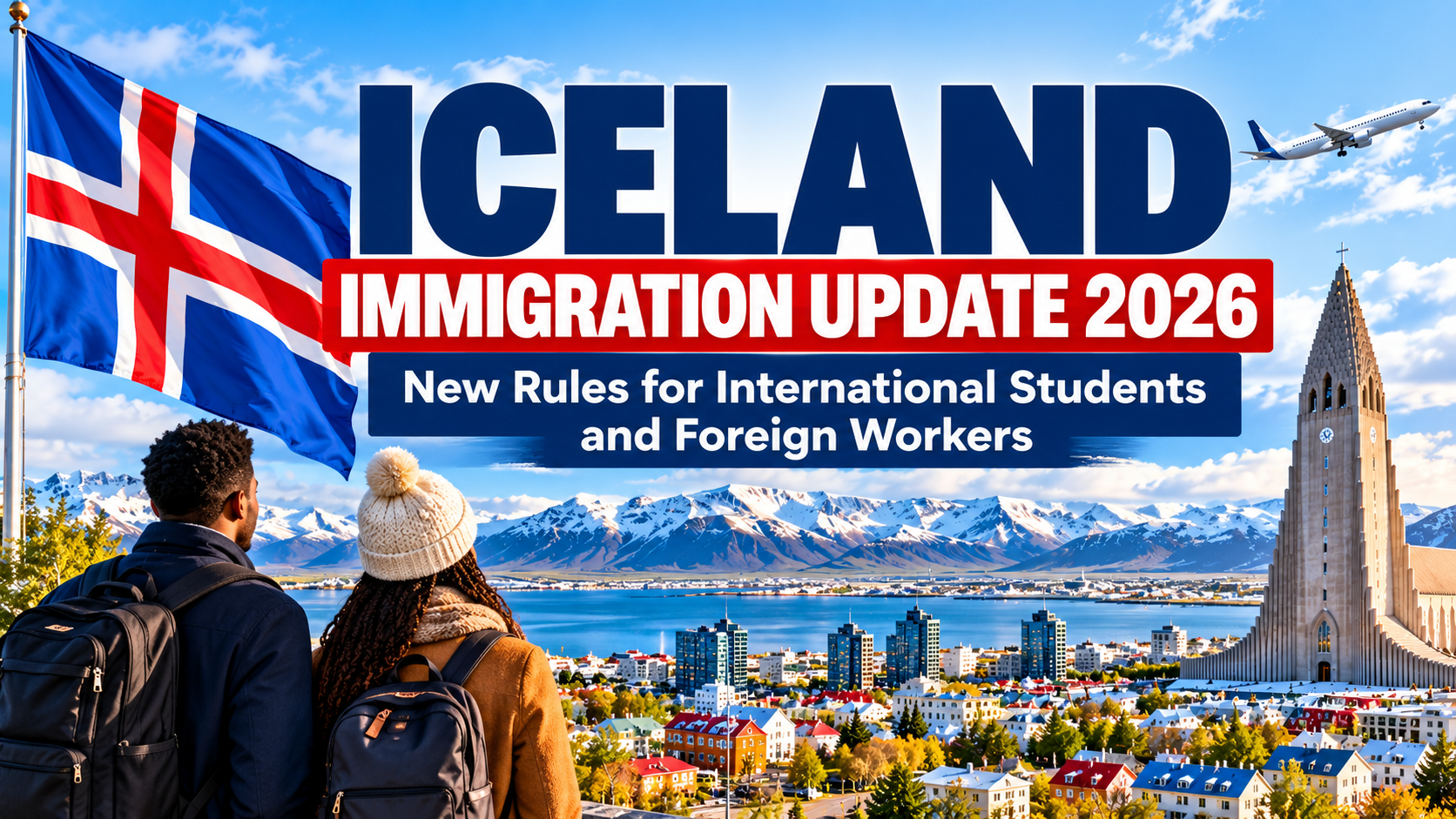
Are you planning to study, work or build a career in Iceland? Important immigration changes introduced in 2026 could affect your plans, especially if you are an international student or a foreign national seeking employment.
On 8 July 2026, amendments to Iceland’s immigration and foreign workers’ legislation took effect. The changes cover student employment rights, academic progress requirements, post-graduation job-search opportunities, family reunification and the processing of work permit applications.
For Nigerians considering Iceland as a study or career destination, understanding these rules before applying is essential. A student residence permit, for example, now comes with specific employment limits and academic requirements that applicants must understand.
In this guide, we explain the key changes, who they affect and what prospective applicants should do next.
1. International Students Can Work Without a Separate Work Permit
One of the most significant changes is that international students holding a valid student residence permit no longer need to obtain a separate work permit to work as employees in Iceland.
Under the new rules, eligible students can work up to 60% of full-time employment while studying.
This is subject to important conditions:
- The 60% limit applies to the student’s combined employment across all employers.
- Students may work full-time during scheduled academic breaks, in accordance with their institution’s academic calendar.
- Self-employment is not permitted under this student employment exemption.
- Students must provide employment information when renewing their residence permits.
- Working beyond the permitted limit may result in a review or loss of the right to work.
Important: Students applying for their first student residence permit must wait until the permit has been issued before starting employment.
For Nigerian students, this change removes the need for a separate work permit but does not mean that studying in Iceland automatically gives you unrestricted permission to work.
2. Students Must Meet Academic Progress Requirements
Iceland has also strengthened its academic progress requirements for international students.
Under the 2026 changes, student residence permit holders must demonstrate satisfactory academic progress every time they renew their permits, rather than only at the first renewal.
The official requirement is to complete at least 75% of a full-time course load during the academic year.
This means that obtaining admission is only one part of the process. Students must also remain academically active and meet the applicable requirements to maintain their legal residence.
Before applying, prospective students should consider:
- Whether their chosen programme suits their academic background.
- Whether they can meet the institution’s workload and assessment requirements.
- How they will finance tuition, accommodation, food and other living expenses.
- Whether their plans to work alongside their studies are realistic.
Students should not rely on part-time employment as their only source of funding without carefully assessing the risks.
3. Post-Study Job-Search Opportunities Reduced to 18 Months
Graduating from an Icelandic university can provide a pathway towards professional employment. However, the period available for eligible graduates to seek employment has changed.
Under the new rules, foreign nationals who complete a qualifying bachelor’s, master’s or doctoral degree at an Icelandic university may renew their student residence permit for up to 18 months to seek employment based on their qualifications.
Previously, the maximum period was up to three years.
The post-study arrangement is intended to help eligible graduates transition from education into work requiring their qualifications. It is not an automatic guarantee of employment or permanent residence.
Graduates should therefore use their time strategically by:
- Building relevant professional skills before graduation.
- Seeking internships and networking opportunities where permitted.
- Preparing an Icelandic-standard CV and professional application documents.
- Researching employers and positions that match their qualifications.
- Understanding the requirements for changing to an appropriate work-based residence permit.
Students considering Iceland should evaluate their long-term career prospects before choosing a programme, particularly if their main objective is to remain in the country after graduation.
4. Family Reunification Rules for International Students Have Changed
The 2026 changes also affect international students who wish to bring family members to Iceland.
Eligibility for family reunification through a student residence permit is now restricted to students enrolled in full-time university studies leading to a bachelor’s, master’s or doctoral degree.
The changes mean that:
- Eligible students may apply for family reunification with a spouse or qualifying cohabiting partner.
- Eligible students may apply for family reunification with children under 18, subject to the applicable requirements.
- Students enrolled in diploma programmes are no longer eligible for family reunification under these student rules.
- The previous right to family reunification with parents under this route has been removed.
These restrictions are particularly important for married applicants and students with children.
If you intend to relocate with your family, confirm the rules that apply to your specific programme and circumstances before accepting an admission offer or paying application-related fees.
Do not assume that every student residence permit allows a spouse, children or parents to accompany the student.
5. Iceland Has Changed How Work Permit Applications Are Processed
Another major administrative change took effect on 8 July 2026.
Responsibility for processing and issuing temporary work permits was transferred from the Directorate of Labour to the Directorate of Immigration.
This means applicants and employers must follow the relevant procedures and guidance provided by the Directorate of Immigration.
The transition may also affect processing times as administrative systems and procedures are adjusted.
For foreign professionals hoping to work in Iceland, it is important to distinguish between a job offer, a work permit where required, and permission to reside in the country. These are related but separate matters, and meeting one requirement does not automatically satisfy all the others.
Before submitting an application, applicants should check the current documentation requirements, eligibility criteria and procedures with the Icelandic authorities.
6. Complete Applications and Document Credibility Matter
The updated rules also give Iceland’s Directorate of Immigration clearer authority to prioritise certain applications and assess the reliability of supporting documents.
Complete employment-based applications may be prioritised ahead of other applications. Certain time-sensitive applications, including qualifying student applications submitted before the academic year begins, may also receive priority.
The regulations additionally address situations where there are reasonable grounds to doubt the authenticity or credibility of documents submitted in support of a residence permit application.
For applicants, the practical message is clear:
- Provide genuine academic certificates and transcripts.
- Submit accurate financial and personal information.
- Ensure that employment documents and supporting letters are authentic.
- Follow the current application instructions.
- Submit a complete application within the relevant deadline.
False, misleading or unreliable documentation can put an application at risk. Applicants should never purchase fabricated admission letters, employment offers, bank statements or other supporting documents.
7. New Short-Term Residence Permit Provisions
The updated regulations also establish a framework for certain short-term residence permits.
These permits are intended for eligible foreign nationals who wish to remain in Iceland for more than 90 days but no longer than 180 days for specified purposes.
The stated categories include visiting a close family member or visiting Iceland as an artist, scientist or athlete.
These provisions are distinct from the ordinary student and work-based residence routes. Eligibility depends on the relevant conditions, so applicants should not assume that a short-term residence permit provides permission to take up regular employment or enrol in any programme.
What Do the New Iceland Rules Mean for Nigerians?
For Nigerians considering Iceland, the changes create both opportunities and important restrictions.
For prospective students: The removal of the separate work permit requirement for eligible student permit holders may simplify the process of working alongside studies. However, the 60% work limit and academic progress requirements must be taken seriously.
For graduates: The shorter, 18-month job-search period makes early career planning more important. Students should research employment opportunities in their fields before choosing a programme.
For married applicants and parents: Family reunification eligibility should be assessed before making relocation plans, especially for applicants considering diploma-level studies.
For foreign professionals: Applicants seeking employment should use the current procedures provided by Iceland’s Directorate of Immigration and ensure that their documents and employment arrangements meet the applicable requirements.
The best approach is to treat studying or working in Iceland as a structured immigration plan, not simply an opportunity to travel abroad.
How to Prepare for Studying or Working in Iceland
If Iceland is one of your preferred destinations, consider these practical steps:
- Choose the right pathway. Decide whether you intend to study, pursue professional employment or qualify through another residence category.
- Verify your eligibility. Check the official requirements for your nationality, programme, qualifications and intended residence route.
- Prepare your documents. Gather genuine academic records, identification, financial evidence and other documents required for your application.
- Plan your finances. Calculate tuition, accommodation, living costs, insurance where applicable and application fees. Do not assume that part-time employment will cover all your expenses.
- Understand your work rights. If you are applying as a student, understand the 60% limit and the conditions under which full-time work is permitted.
- Plan beyond graduation. Research employers, career opportunities and the requirements for transitioning to a suitable residence permit before your programme ends.
- Check official updates. Immigration requirements can change. Verify the latest instructions before paying fees or submitting an application.
Frequently Asked Questions
Can international students work in Iceland in 2026?
Yes. Eligible holders of a valid student residence permit can work as employees without a separate work permit, subject to the 60% full-time employment limit while studying and other applicable conditions.
Can Nigerian students work full-time while studying in Iceland?
Generally, no. The usual limit is 60% of full-time employment while studying. Full-time work may be permitted during scheduled academic breaks and in certain other specified circumstances.
How long can graduates stay in Iceland to look for work?
Eligible graduates who complete a qualifying bachelor’s, master’s or doctoral degree at an Icelandic university may renew their student residence permit for up to 18 months to seek employment based on their qualifications.
Can I take my spouse and children to Iceland as a student?
Family reunification may be available to eligible students enrolled in full-time university degree programmes leading to a bachelor’s, master’s or doctoral qualification. Specific eligibility conditions apply. Diploma students are not eligible under the updated student family reunification rules.
Does admission to an Icelandic university guarantee a residence permit?
No. Admission is only one part of the process. Applicants must meet the applicable immigration requirements and provide the required supporting documents.
Where can I confirm the latest Iceland immigration rules?
The official Icelandic Directorate of Immigration provides details of the changes. Applicants should also consult the relevant official guidance for student residence permits and work-based residence permits.
Conclusion
Iceland’s 2026 immigration changes are important for international students, graduates, families and foreign professionals. While eligible students can now work without a separate work permit, they must observe employment limits, maintain satisfactory academic progress and comply with residence permit conditions.
Graduates also have a shorter period to seek qualifying employment, while family reunification rules have become more restrictive for some students.
For Nigerians planning to study or work in Iceland, careful preparation is essential. Research your options, verify your eligibility and make sure your immigration strategy reflects the rules currently in force.
Planning to study or work abroad?
Zinchi International helps Nigerians explore international education and overseas opportunities, prepare their applications and understand the requirements involved in pursuing their goals abroad.
Contact Zinchi International to discuss your plans and identify the next steps for your intended destination.
Disclaimer: This article is for general information and educational purposes only. Immigration decisions depend on individual circumstances and current legislation. It is not legal advice, and no visa or residence permit outcome is guaranteed.
Official source: Icelandic Directorate of Immigration, “New residence and work permit rules take effect,” 8 July 2026.