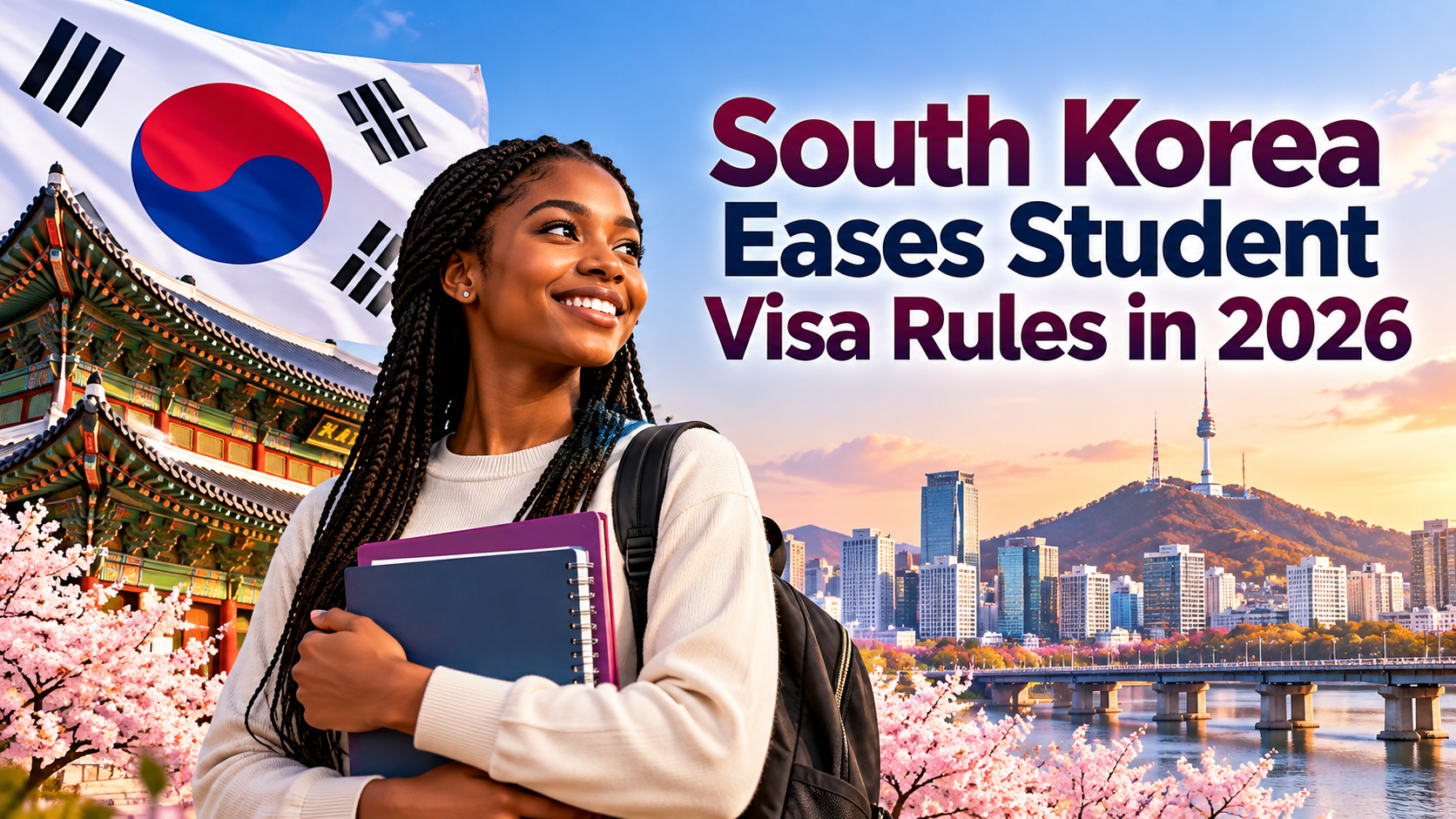
South Korea is planning major changes to its international student visa system that could make the country a more attractive destination for students from Nigeria and other parts of the world. The proposed reforms include a conditional exemption from proof-of-funds requirements for eligible students, simplified part-time work procedures and improved pathways for international graduates seeking employment.
Announced by South Korea’s Ministry of Justice on October 7, 2026, the measures aim to help international students progress from education to employment and, where eligible, longer-term residence.
For Nigerian students considering studying abroad, these developments could create new opportunities. However, the reforms are being introduced in stages, and applicants should understand the eligibility conditions before making decisions about their studies or visa applications.
1. Eligible Students Could Be Exempt from Proof-of-Funds Requirements
One of the most significant proposed changes concerns the financial documents international students must provide when applying for a student visa.
Under the announced plan, students who demonstrate a specified level of Korean-language proficiency will be exempt from submitting separate proof of financial means for their visa applications.
The qualifying language standards include:
- TOPIK Level 4 or higher: The Test of Proficiency in Korean measures a person’s ability to understand and use Korean.
- KIIP Level 4: Level 4 of the Korea Immigration and Integration Program is another qualifying standard identified in the announcement.
This could be particularly helpful for students who have invested time in learning Korean before applying to a South Korean university.
However, the exemption does not mean every international student will automatically qualify. The government also plans to strengthen financial safeguards in cases requiring closer immigration scrutiny, including certain higher-risk cases involving unauthorised employment or overstaying.
Nigerian applicants should therefore confirm whether the exemption applies to their circumstances before relying on it.
What this means for Nigerian students: Learning Korean could become an important part of your study-abroad preparation. Nevertheless, you should continue preparing the financial documents required under the rules applicable to your application until the relevant exemption is confirmed.
2. South Korea Plans to Simplify Part-Time Work Procedures
Many international students look for part-time employment to gain practical experience and help manage their living expenses while studying.
South Korea’s proposed reforms seek to simplify the process for international students who qualify for part-time work.
Under the announced measures, the assessment of eligibility will focus more clearly on Korean-language proficiency and academic performance. The government also plans to simplify documentation for eligible students who obtain the required confirmation from their universities.
However, these changes do not give international students unrestricted permission to work.
Students must still comply with the immigration conditions attached to their status and obtain the necessary authorisation where required. Their eligibility, permitted activities and working hours will depend on the applicable rules.
For Nigerian students, developing Korean-language skills could provide advantages beyond the classroom. It may help with communication, integration into Korean society and access to certain employment opportunities.
Before accepting a job, students should confirm the current requirements with their university’s international student office or the relevant immigration authority.
3. Graduates Could Receive One to Three Years to Seek Employment
Another important part of the reform package concerns international students who want to remain in South Korea after graduation.
The government plans to differentiate the permitted job-seeking period under the D-10 job-seeking visa according to factors such as Korean-language proficiency and readiness for employment.
Under the announced plan, eligible graduates could receive job-seeking stays ranging from one to three years, depending on the applicable criteria.
This could give graduates additional time to search for suitable jobs, attend interviews and pursue employment opportunities related to their qualifications.
For Nigerian students comparing international study destinations, post-study opportunities are an important factor to consider. Studying in a country where graduates can pursue eligible employment pathways may provide additional value beyond the academic qualification itself.
However, a longer job-seeking period does not guarantee a job, permanent residence or automatic permission to undertake employment. Graduates must satisfy the requirements associated with their immigration status and any subsequent work visa.
4. New Employment Pathways for Science and Engineering Graduates
South Korea is also seeking to attract and retain international graduates with skills that meet its labour-market needs.
The announced reforms include plans to make it easier for eligible science and engineering graduates to transition to skilled-worker status when they meet the relevant conditions and take qualifying jobs in fields such as manufacturing.
The government is also reviewing a specialised visa pathway, provisionally called the K-Tech Master Visa, intended to help graduates of certain specialised technical master’s programmes transition from a student visa to an eligible residence status.
These proposals could be particularly relevant to international students interested in:
- Engineering and advanced manufacturing
- Information technology and related technical fields
- Science and research
- Specialised technical postgraduate programmes
The availability of these pathways will depend on the final rules, the applicant’s qualifications, Korean-language ability, employment circumstances and other eligibility requirements.
Students should therefore research their intended course carefully and consider its academic quality and realistic career prospects rather than choosing a programme solely because of a proposed visa benefit.
5. South Korea Is Considering a New Gap-Year Student Visa
The reform package also includes a proposed gap-year student visa category, provisionally referred to as the D-2-8 visa.
The proposed pathway is intended to allow eligible students from overseas to explore educational or career opportunities in South Korea.
This could offer additional flexibility for people who want to learn more about the country’s education system and potential career pathways before committing to a conventional degree programme.
However, the proposal is still subject to the relevant implementation arrangements. Prospective applicants should not assume that the visa is already available or that it guarantees admission to a university, employment or permission to remain in the country indefinitely.
Students interested in this option should monitor official announcements for the final eligibility requirements and application procedures.
6. What Do the Reforms Mean for Nigerian Students?
For Nigerians considering studying abroad, the proposed changes could make South Korea worth investigating alongside more familiar destinations such as the United Kingdom, Canada and the United States.
The potential benefits include a conditional exemption from financial documentation requirements, simplified part-time work procedures and more clearly differentiated post-graduation job-seeking periods.
However, the best destination depends on your academic qualifications, budget, preferred course, language skills and long-term plans.
Before applying to study in South Korea, consider the following steps.
Research Suitable Universities
Identify universities and programmes that match your qualifications and career goals. Review admission requirements, tuition fees, application deadlines and whether your preferred course is taught in Korean or English.
Understand the Financial Requirements
Prepare a realistic budget covering tuition, accommodation, food, health insurance, transport and other living expenses.
Even if you eventually qualify for an exemption from submitting proof of financial means, you will still need a practical plan for covering your expenses.
Consider Learning Korean
Determine the language requirements for your chosen programme. Even when a course is taught in English, Korean-language proficiency can help you communicate, adapt to daily life and explore future employment opportunities.
Prepare Your Academic Documents
Gather your academic certificates, transcripts, passport and any language-test results required by your university or visa category.
Make sure all documents are genuine and meet the institution’s application requirements.
Verify the Current Visa Rules
Do not rely exclusively on social media posts or headlines when making immigration decisions. Check the official guidance applicable to your intended visa category and confirm whether the specific reform you want to rely on has taken effect.
7. When Will the New Rules Take Effect?
Although South Korea announced the reform package on October 7, 2026, not every measure is necessarily available for immediate use.
According to the Ministry of Justice, measures that can be implemented within its own authority are scheduled to begin implementation in the second half of 2026. Other proposals that require coordination with additional government agencies will need further development.
Students should distinguish between an announced reform, a measure being prepared for implementation and a rule that is already operational.
Before paying a non-refundable university deposit or submitting a visa application based on one of these changes, confirm the latest requirements with the relevant authorities.
For official updates, visit:
Frequently Asked Questions
Can Nigerians benefit from South Korea’s student visa reforms?
Potentially, yes. The announced reforms concern international students, but eligibility for individual measures depends on the final rules, implementation status and the applicant’s circumstances.
Will Nigerian students still need proof of funds?
Students should continue preparing the financial documents required under the rules applicable to their applications. The announced exemption is linked to specified Korean-language proficiency standards and should not be treated as universally available.
Can international students work part-time in South Korea?
Eligible students may undertake permitted part-time work if they meet the applicable conditions and obtain the necessary authorisation. The proposed reforms aim to simplify certain procedures, not eliminate all restrictions.
Can I stay in South Korea after graduation?
Eligible graduates may pursue the appropriate job-seeking or employment status if they satisfy the relevant requirements. The announced plan provides for job-seeking stays of one to three years depending on eligibility, but this is not an automatic entitlement for every graduate.
Do I need to speak Korean to study in South Korea?
Not necessarily. Language requirements vary by institution and programme, and some courses are taught in English. However, Korean-language proficiency could be beneficial for daily life, employment and eligibility for certain measures under the proposed reforms.
Does the new policy guarantee a South Korean visa?
No. Applicants must still satisfy the requirements applicable to their visa category. The reforms do not guarantee admission, visa approval, a scholarship, employment or permanent residence.
Final Thoughts
South Korea’s proposed student visa reforms could create new opportunities for international students, including Nigerians who want to pursue an overseas education and explore career opportunities after graduation.
The conditional exemption from proof-of-funds requirements, simplified part-time work procedures and proposed employment pathways are developments worth monitoring.
However, applicants should not make decisions based on assumptions that every change is already in force. The details of implementation and individual eligibility remain important.
If South Korea is one of your preferred study destinations, start researching suitable universities, reviewing admission requirements and preparing your documents. Learning Korean and developing a clear academic plan may also strengthen your preparation.
Planning to Study Abroad?
At Zinchi International, we help aspiring international students explore study destinations, identify suitable institutions, prepare applications and understand visa requirements.
Whether you are considering South Korea or comparing it with other destinations, our team can help you explore your options and plan your next steps.
Contact Zinchi International today to discuss your study-abroad plans and take the next step towards your international education goals.
Disclaimer: This article is for general informational purposes only. Immigration policies and visa requirements can change. The announced reforms may be subject to implementation and eligibility conditions. Always verify the latest official requirements before applying.
Sources
- South Korea Ministry of Justice — Official announcement on international student visa reforms
- Seoul Economic Daily — Korea to Revamp Student Visas as Foreign Enrollment Hits 350,000
- The Straits Times — South Korea plans to ease student visa rules