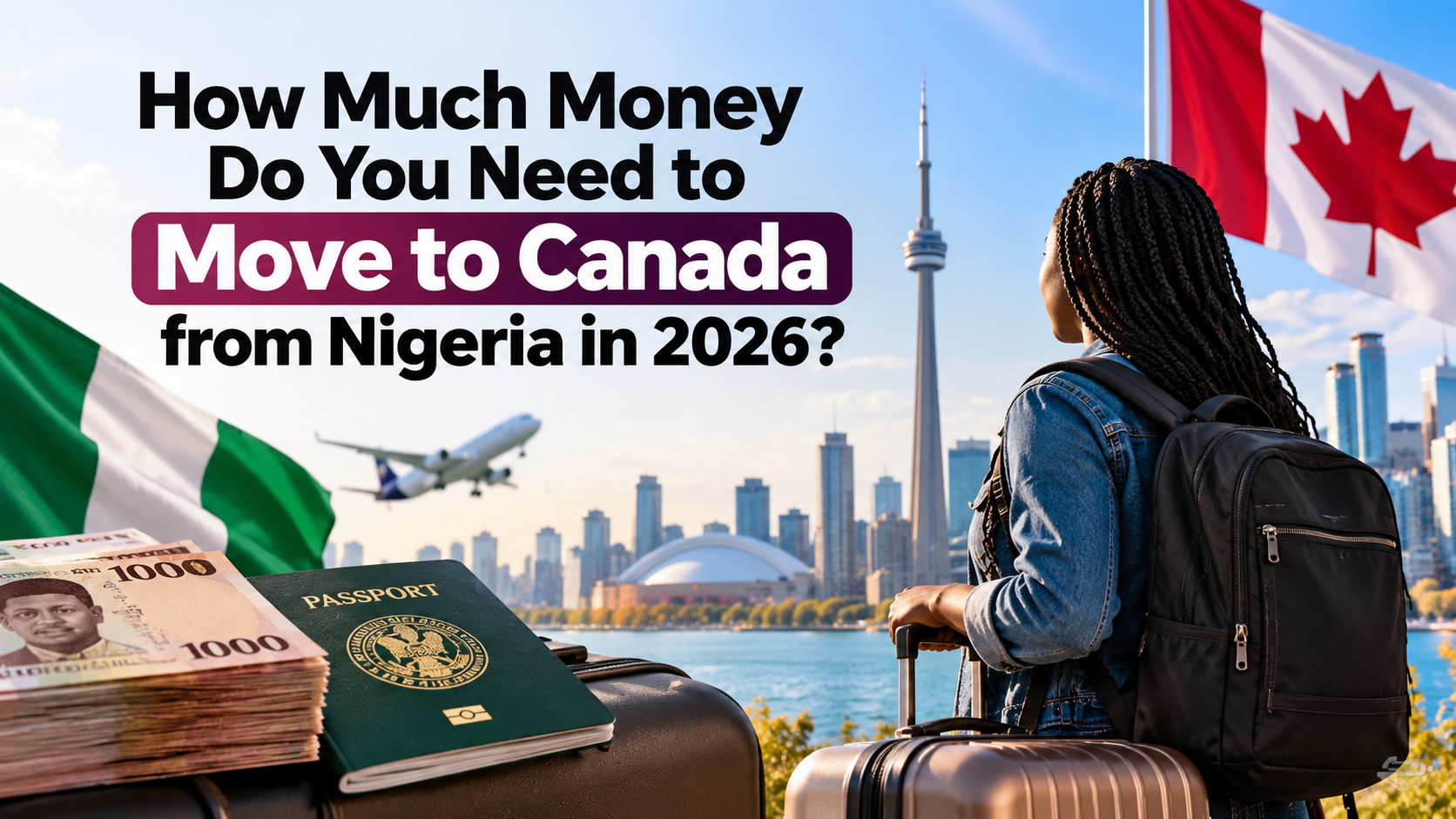
Planning to relocate from Nigeria to Canada? Before you start your immigration application, one important question you need to answer is: How much money do you need to show as proof of funds?
Whether you are moving alone, relocating with your spouse, or planning to move with your entire family, your financial requirements will depend on your immigration pathway, family size, and the type of application you are submitting.
In this guide, we explain Canada’s proof of funds requirements, how much money you may need, the documents to prepare, and common mistakes Nigerian applicants should avoid.
What Is Proof of Funds?
Proof of funds is evidence that you have sufficient money to support yourself and, where applicable, your family after arriving in Canada.
Canadian immigration authorities use this evidence to assess whether you can meet your financial needs without depending on unauthorised employment or other forms of financial assistance.
Depending on your immigration pathway, you may need to demonstrate that you have enough money for settlement expenses, tuition fees, living costs, transportation, and other necessary expenses.
Important: There is no single amount that applies to everyone moving to Canada. The required amount depends on whether you are applying for permanent residence, a study permit, or another immigration category.
1. How Much Money Do You Need for Canada Express Entry?
For Nigerians applying for permanent residence through Express Entry, proof of funds is particularly important under the Federal Skilled Worker Program and the Federal Skilled Trades Program.
The Canadian government publishes minimum settlement fund requirements based on the size of your family.
According to Immigration, Refugees and Citizenship Canada (IRCC), the published minimum amounts, updated on July 7, 2025, are as follows:
| Family size | Minimum funds required (CAD) |
|---|---|
| 1 person | $15,263 |
| 2 people | $19,001 |
| 3 people | $23,360 |
| 4 people | $28,362 |
| 5 people | $32,168 |
| 6 people | $36,280 |
| 7 people | $40,392 |
| Each additional family member | $4,112 |
Source: IRCC – Express Entry proof of funds.
These are Canadian dollar amounts, not Nigerian naira. The naira equivalent will depend on the prevailing exchange rate.
Who counts as a family member?
When calculating your family size, you must generally include:
- Yourself.
- Your spouse or common-law partner.
- Your dependent children.
- Your spouse or common-law partner’s dependent children.
You must include eligible family members even if they will not travel to Canada with you.
For example, if you are married and have one dependent child, your family size will generally be three, even if you intend to travel alone initially.
Do you need to show the exact minimum amount?
The figures above are the published minimum requirements, not recommended budgets for every possible expense.
You should ensure that your available funds meet the applicable requirement and consider keeping additional money for airfare, accommodation, initial living expenses, and unexpected costs.
Always confirm the latest amount on the official IRCC website before submitting your application.
2. What If You Want to Move to Canada Through a Study Permit?
If your plan is to relocate from Nigeria to Canada as an international student, your financial requirements are different from the Express Entry settlement fund requirements.
You generally need to demonstrate that you can afford:
- Your tuition fees.
- Your living expenses.
- Transportation to and from Canada.
- Living expenses for accompanying family members, where applicable.
For study permit applications submitted on or after September 1, 2026, applicants studying outside Quebec must show the following amount for one year of living expenses, excluding tuition and transportation:
| Family size | Required living expenses (CAD) |
|---|---|
| 1 person | $23,448 |
| 2 people | $29,192 |
| 3 people | $35,888 |
| 4 people | $43,572 |
| 5 people | $49,419 |
| 6 people | $55,736 |
| 7 people | $62,054 |
| Each additional family member | $6,318 |
These figures apply to the living expense requirement for the relevant study permit applications outside Quebec. Tuition and transportation costs must be accounted for separately.
Example: If you are a Nigerian student applying alone, you need to budget for at least CAD $23,448 in living expenses for one year, in addition to your tuition and transportation costs.
For a family of three, the living expense requirement is CAD $35,888, before adding tuition and transportation.
For the latest requirements, consult the official IRCC study permit financial support guide.
3. How Can Nigerians Prove They Have the Money?
Having the required amount is only part of the process. You must also provide credible documentation demonstrating that the funds are genuinely available to you.
For Express Entry applications, acceptable evidence can include official letters from banks or financial institutions where you hold accounts.
Your bank letters should contain the required information, including:
- Your name and relevant account details.
- The date each account was opened.
- Current account balances.
- Average balances over the preceding six months.
- Outstanding debts and loans.
- The financial institution’s contact details.
Your money must be legally accessible to you when you arrive in Canada. For Express Entry, borrowed money and the equity in real estate cannot be used as settlement funds.
For study permit applications, bank statements, evidence of scholarships, education loans, and documented financial support from a sponsor may be relevant, depending on your circumstances.
Read the official requirements for your particular immigration pathway before preparing your documents.
4. Can Your Parents, Spouse, or Sponsor Provide the Money?
Yes, financial support from another person may be relevant, particularly for study permit applications.
For example, a parent may sponsor a student’s education, or a spouse may contribute towards the family’s relocation expenses.
However, you should not assume that money in another person’s account automatically satisfies every proof of funds requirement.
For a study permit, supporting evidence may include:
- A sponsorship or financial support letter.
- Proof of the relationship between you and your sponsor.
- Your sponsor’s bank statements.
- Evidence of your sponsor’s income or employment.
- Documents explaining how your expenses will be covered.
For Express Entry, the rules governing access to settlement funds are different. If you intend to rely on money held by your spouse or another person, confirm that the arrangement meets IRCC’s requirements.
The goal is to demonstrate both the availability of the money and your legal access to it.
5. Does the Money Have to Be in a Canadian Bank?
Not necessarily.
Nigerian applicants can generally use eligible funds held in Nigerian bank accounts, provided they meet the relevant immigration requirements and can demonstrate access to the money.
For Express Entry, the financial institution’s letter must contain the required account and balance information.
For study permits, IRCC accepts several forms of financial evidence, including statements from Canadian or foreign bank accounts, subject to the applicable requirements.
If your money is held in naira, remember that the Canadian dollar value will depend on the exchange rate used to assess your financial position.
It is sensible to maintain a financial buffer rather than relying on an amount that barely meets the minimum threshold.
6. Will a Large Deposit in Your Account Guarantee Visa Approval?
No.
A substantial bank balance does not automatically guarantee approval of a Canadian immigration application.
Immigration officers may assess the overall evidence, including the source of your funds, the credibility of your documents, your eligibility, and whether you satisfy the requirements of the immigration category.
If a large amount suddenly appears in your account, be prepared to explain where it came from and provide supporting evidence where necessary.
Avoid submitting false bank statements, misleading sponsorship letters, or financial documents that you cannot verify. Such practices can seriously damage your application and may have legal consequences.
7. Do All Applicants Need to Show Proof of Funds?
No. The requirements depend on the immigration programme.
For Express Entry, proof of funds is generally required under the Federal Skilled Worker Program and Federal Skilled Trades Program, subject to applicable exemptions.
Applicants under the Canadian Experience Class do not need to meet the Express Entry settlement fund requirement. Certain applicants with a valid job offer and authorisation to work in Canada may also be exempt under the applicable rules.
Study permit applicants have separate financial support requirements.
Therefore, before raising money or preparing bank statements, identify the immigration pathway that applies to your situation.
8. Practical Tips for Nigerians Preparing Their Proof of Funds
Before submitting your application, consider these steps:
1. Confirm your immigration pathway. Determine whether you are applying through Express Entry, a study permit, or another programme.
2. Calculate your family size correctly. Include the family members required under the relevant rules, even when they will not accompany you.
3. Obtain official financial documents. Request bank letters and statements that meet the requirements of your application.
4. Document the source of your money. Keep evidence of salary payments, business income, savings, property sales, or other legitimate sources where relevant.
5. Allow for exchange rate fluctuations. Your naira savings may change in Canadian dollar value, so avoid planning around the bare minimum.
6. Check the official requirements again before applying. Immigration rules and financial thresholds can change.
7. Plan for expenses beyond proof of funds. Application fees, medical examinations, document processing, flights, accommodation, and other costs may increase the amount you need overall.
Frequently Asked Questions
How much money does a single Nigerian need to move to Canada?
For Express Entry, the published minimum settlement fund amount for one person is CAD $15,263, according to the IRCC table updated on July 7, 2025. Study permit applicants have a different financial requirement, and other immigration pathways may have different rules.
Can I use my Nigerian bank statement as proof of funds?
Yes, eligible funds held in a Nigerian bank account may be accepted, provided your documents meet the requirements of the immigration pathway and establish that the money is genuinely available to you.
Can I borrow money to show proof of funds?
For Express Entry settlement funds, you cannot borrow the required money from another person. Study permit financial requirements are assessed separately, and a qualifying education loan may be accepted as evidence of financial support.
Does proof of funds guarantee a Canadian visa?
No. Proof of funds is only one part of the application. You must also meet the other eligibility, documentation, and admissibility requirements that apply to your immigration category.
Can I include my spouse and children in my application?
Yes, where your immigration pathway permits or requires family members to be included. Their presence will affect your financial calculations, and the relevant family-size rules must be followed.
Conclusion: Start Your Canadian Immigration Journey with the Right Financial Plan
Moving from Nigeria to Canada requires careful planning, and proof of funds is an important part of that preparation.
The amount you need will depend on your immigration pathway, family size, and the expenses you must cover. Meeting the minimum financial threshold is a starting point, not a guarantee of approval.
Before you begin your application, verify the current requirements, prepare genuine financial documents, and ensure that your funds are accessible and adequately documented.
Need help planning your move to Canada?
Zinchi International assists Nigerians with study abroad guidance, visa processing, and immigration-related application support. Contact our team to discuss your goals and understand the requirements that may apply to your circumstances.
Disclaimer: This article is for general informational purposes and does not constitute legal or immigration advice. Immigration requirements can change. Always consult the official Government of Canada website or a properly authorised immigration professional for guidance specific to your situation.